Interconnecting Networks
- Cloud VPN
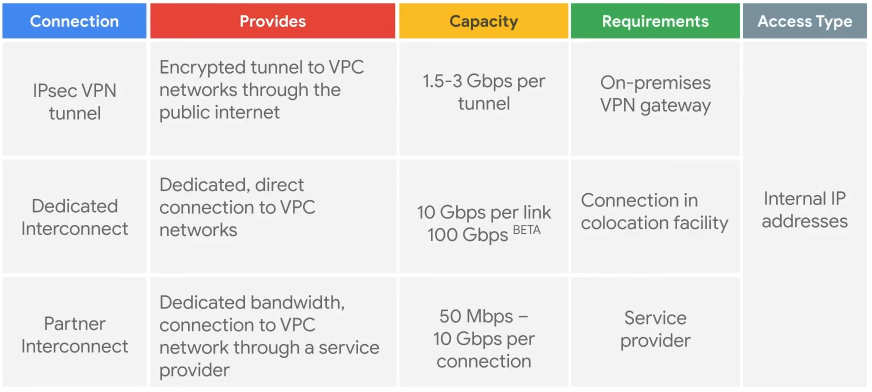
- Securely connects on-premises network to GCP VPC network using an IPSec VPN tunnel
- IPSec: IPsec is commonly used to secure VPNs. While a VPN creates a private network between a user’s computer and the VPN server, IPsec protocols implement a secure network that protects VPN data from outside access
- Useful for low-volume data connections
- 99.9% SLA
- Supports:
- Site-to-site VPN
- Static & Dynamic routes (Cloud Router)
- IKEv1 & IKEv2 ciphers (Internet Key Exchange)
- Securely connects on-premises network to GCP VPC network using an IPSec VPN tunnel
- Dynamic routes (Cloud Router)
- BGP (Border Gateway Protocol)
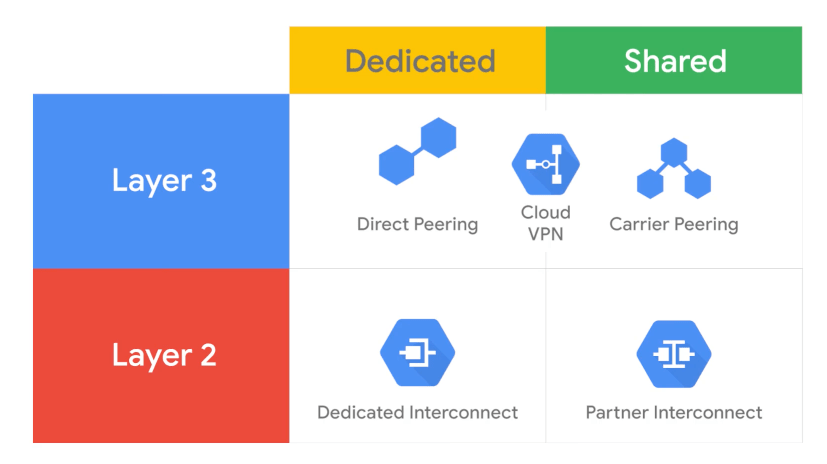
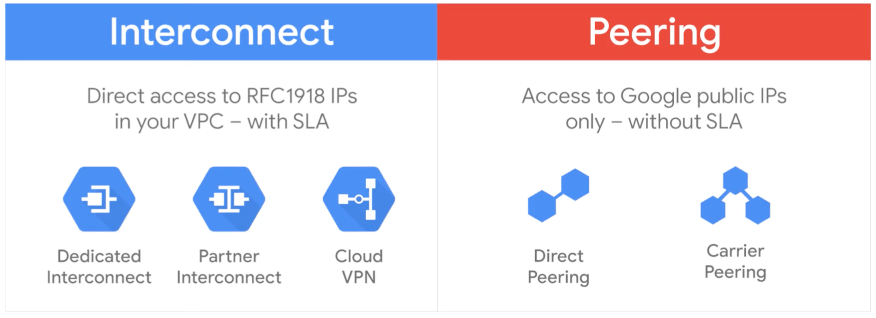
- Cloud Interconnect
- Dedicated Interconnect provides direct physical connection between your on-premises network and GCP network
- Requirement: A cross-connect between the google network and router in a common co-location facility to establish a BGP session (The two routers themselves cannot establish BGP session?)
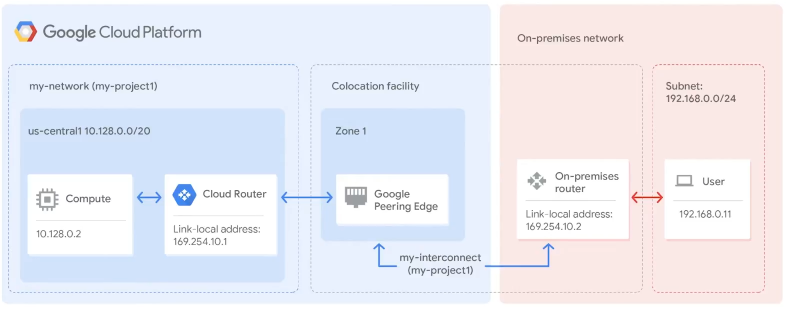
- Requirement: A cross-connect between the google network and router in a common co-location facility to establish a BGP session (The two routers themselves cannot establish BGP session?)
- Partner Interconnect provides connectivity through a supported service provider
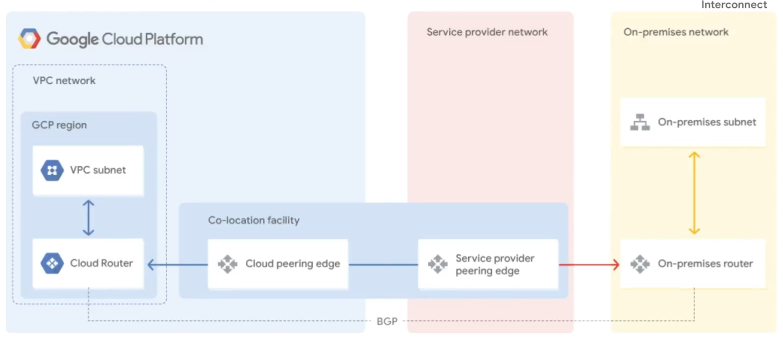
- Dedicated Interconnect provides direct physical connection between your on-premises network and GCP network
- Comparison
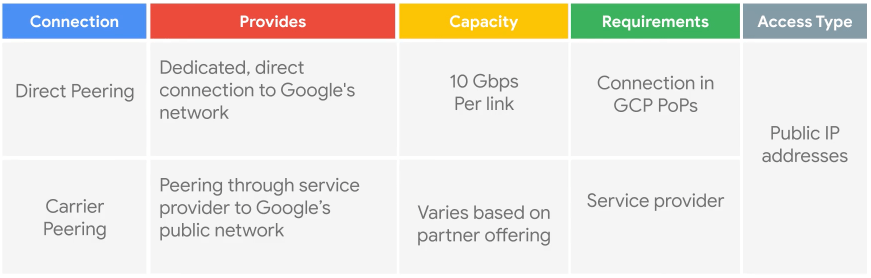
- Peering
- Peering is a method that allows two networks to connect and exchange traffic directly without having to pay a third party to carry traffic across the Internet
- Direct Peering provides a direct connection between your business network and Google’s
- Broad-reaching edge network locations
- Exchange BGP routes
- Reach all of Google’s services
- Peering requirements
- No SLA
- Edge Points of Presence (PoPs)
- Where google’s network connects to the rest of the internet
- Carrier Peering provides connectivity through a supported partner
- Carrier Peering partner
- Reach all of Google’s services
- Partner requirements
- No SLA
- Sharing VPC Networks
- Shared VPC
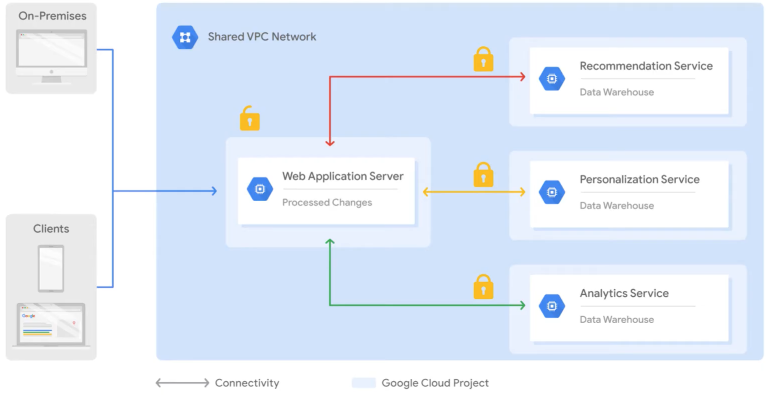
- Allows an organization to connect resources from multiple projects to a common VPC network
- A host project
- Communicate within Shared VPC using private IP, host project with external networks using public IP
- VPC peering
- Bi-directional peering, then communicate with private IP addresses even in different organizations
- Decentralized or distributed approach to multi project networking
- Shared VPC
Load Balancing and Autoscaling
- Managed Instance Groups
- Deploy and manage identical VM instances based on template
- Instance group can be resized
- Manager ensures all instances are running
- Typically used with autoscaler to offer autoscaling capabilities
- Dynamically add/remove instances
- Autoscaling policy:
- CPU utilization
- Load balancing capacity
- Monitoring metrics
- Queue-based workload
- Can be single zone or regional
- Health check
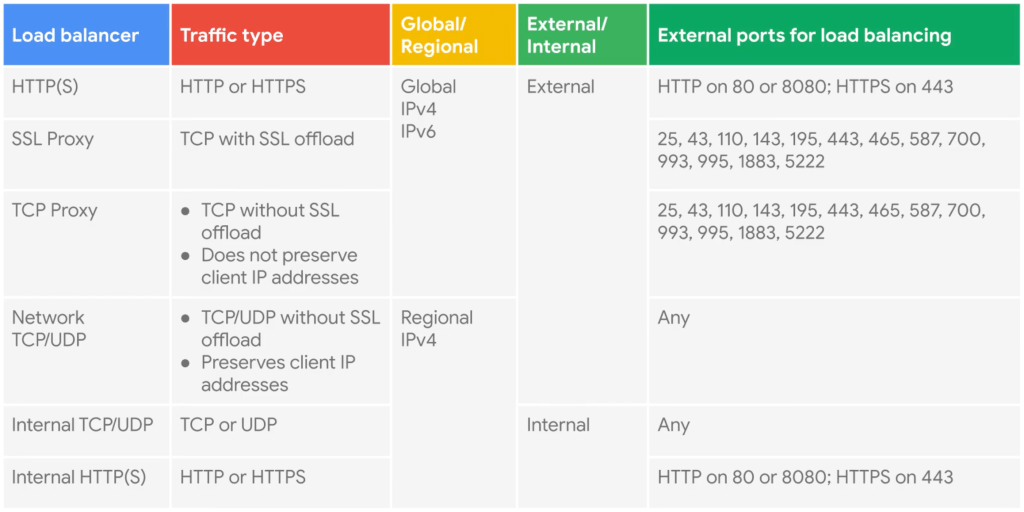
- HTTP(S) Load Balancing
- Layer 7 of OSI model
- Global load balancing
- Single anycast IP address
- Anycast is a network addressing and routing methodology in which a single destination IP address is shared by devices in multiple locations
- HTTP on port 80 or 8080, HTTPs on port 443
- IPv4 & IPv6
- Autoscaling, prewarming-free
- URL maps, default closest (?)
- Backend services

- Health check
- Session affinity (optional, default round robin algo ?)
- Time out setting (30s default)
- One or more backends
- An instance group (managed or unmanaged)
- A balancing mode (CPU utilization or RPS)
- A capacity scaler
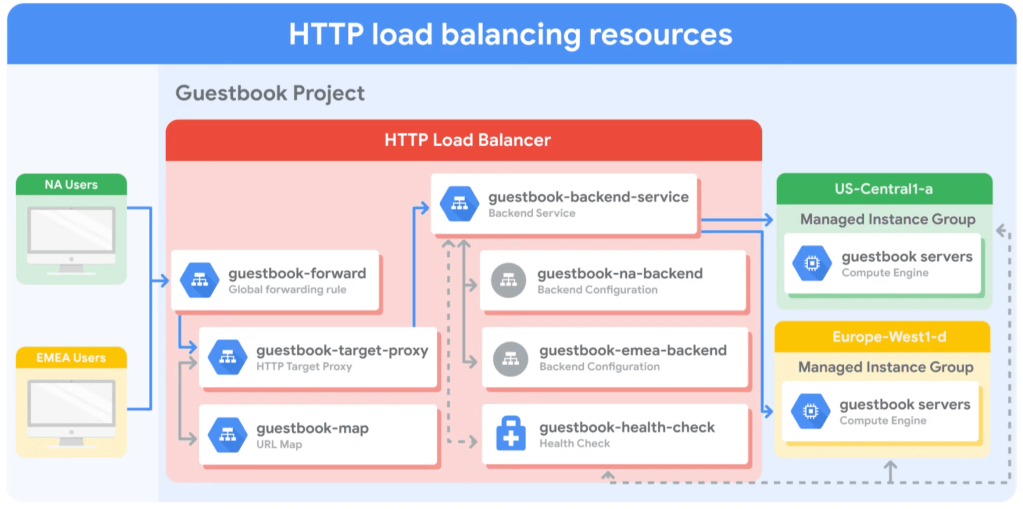
- HTTP(S) load balancing
- Target HTTP(S) proxy
- One signed SSL certificate installed
- Client SSL session terminates at the load balancer
- Support the QUIC transport layer protocol
- SSL certificates
- Required for HTTP(S) load balancing
- Up to 10 SSL certificates (per target proxy)
- Create an SSL certificate resource
- SSL Proxy Load Balancing
- Global load balancing for encrypted, non-HTTP traffic
- Terminates SSL session at load balancing layer
- IPv4 or IPv6 clients
- Benefits:
- Intelligent routing
- Certificate management
- Security patching
- SSL policies
- TCP Proxy Load Balancing
- Global load balancing for unencrypted, non-HTTP traffic
- Terminates TCP sessions at load balancing layer
- IPv4 or IPv6 clients
- Benefits:
- Intelligent routing
- Security patching
- Network load balancing
- Regional, non-proxied load balancer
- Forwarding rules (IP protocol data)
- Traffic: UDP; TCP/SSL ports
- Backends: Instance group; Target pool
- Target pool resource defines a group of instances that receive incoming traffic from forwarding rules
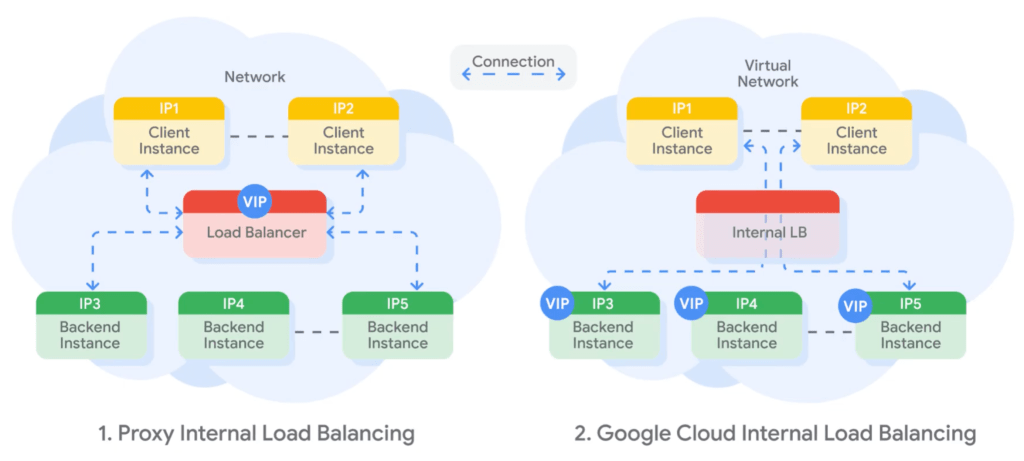
- Internal load balancing
- Regional, private load balancing
- VM instances in the same region
- RFC 1918 IP addresses
- TCP/UDP traffic
- Reduced latency, simpler configuration
- Software-defined, fully distributed load balancing
- Supports 3-tier web services
- Regional, private load balancing

Infrastructure Automation
- Deployment Manager
- An infrastructure deployment service that automates the creation and management of GCP resources
- Repeatable deployment process (Template-driven)
- Declarative language
- Parallel deployment, use reference to indicate dependence
- An infrastructure deployment service that automates the creation and management of GCP resources
- GCP Marketplace
- Quickly deploy functional software packages that run on GCP
- Single bill for GCP and third-party services
- Manage solutions using Deployment Manager
- Notifications when a security update is available
- Direct access to partner support
Managed Services
- BigQuery
- Serverless, highly scalable and cost-effective cloud data warehouse
- Fully managed
- Petabyte scaleSQL interface
- Very fast
- Free usage tier
- Cloud Dataflow
- Serverless, fully managed data processing
- Batch and stream processing with autoscale
- Open source programming using Beam
- Intelligently scale to millions of QPS
- Extract, transform, and load (ETL) orchestration is a common mechanism for building big data pipelines
- Cloud Dataprep
- Visually explore, clean and prepare data for analysis and machine learning
- Serverless, works at any scale
- Suggestion ideal data transformation
- Focus on data analysis
- Integrated partner service operated b Trifacta
- Cloud Dataproc
- A service for running Apache Spark and Apache Hadoop clusters
- Low cost (per-second, preemptible)
- Super fast to start, scale and shut down
- Integrated with GCP
- Managed service
- Simple and familiar
A leased line is a dedicated, fixed-bandwidth data connection.

Terraform is a tool for building, changing, and versioning infrastructure safely and efficiently.
Infrastructure as code is the process of managing infrastructure in a file or files rather than manually configuring resources in a user interface.
Containers in the Cloud
- Infrastructure as a Service allows you to share compute resources with other developers by virtualizing the hardware using virtual machines
- Strong Consistency & Eventual consistency
- Strong Consistency offers up-to-date data but at the cost of high latency
- While Eventual consistency offers low latency but may reply to read requests with stale data since all nodes of the database may not have the updated data
- cURL
- curl is used in command lines or scripts to transfer data
- The name stands for “Client URL”
 Yujin's Amusement Park