Introduction to AWS
Security and Identity
- Data Protection
- Amazon Macie: discover and protect sensitive data
- AWS Key Management Service: store and manage encryption keys
- AWS CloudHSM: Hardware based key storage
- AWS Certificate Manager: provision, manage and deploy SSL and TLS security certificates
- AWS Secrets Manager: rotate, manage and retrieve secrets
- Infrastructure Protection
- AWS Shield: denial of service protection
- AWS Web Application Firewall: filter malicious website traffic
- AWS Firewall Manager: centrally manage firewall rules
- Threat Detection
- Amazon GuardDuty: automatically detect threats
- Amazon Inspector: analyze application security
- AWS Config: record and evaluation configurations of your AWS resources
- AWS CloudTrail: track use activity and API usage
- Identity Management
- AWS IAM: securely manage access to AWS account services and resources
- AWS Single Sign-on: implement cloud single sign-on
- Amazon Cognito: manage identity inside applications
- AWS Directory Service: implement and manage Microsoft Active Directory
- AWS Organizations: centrally govern and manage multiple AWS accounts in one place
Compute
- Instance
- Amazon EC2 (Elastic Compute Cloud): secure and resizable virtual machines in the cloud
- Amazon EC2 Spot: run fault-tolerant workloads at 90% off the normal price
- Amazon EC2 AutoScaling: automatically add or remove capacity based on demand
- Amazon Lightsail: an easy-to-use cloud platform to build applications or websites
- Containers
- Amazon ECS (Elastic Container Service): run secure, reliable and scalable containers
- Amazon ECR: store, manage and deploy container images
- Amazon EKS: fully managed Kubernetes service
- Serverless
- AWS Lambda: a compute service to run code without servers
- Edge
- AWS Outposts: run AWS service on-premises
- AWS Snow Family: bring data into AWS
- AWS Wavelength: access AWS services via 5G networks
- VMWare Cloud on AWS: migrate VMWare workloads
- AWS Local Zones: run latency sensitive applications closer to end users
- Elastic Compute Cloud (EC2)
- Rent virtual computers
- Choose from various types with different CPU, RAM and storage
- Different optimizations are available as well
- Pay by the hour or second
- AWS Lambda
- Serverless compute service
- Runs your code in response to events
- Runs your code for you “somewhere”
- Charged by the millisecond
- Price depends on RAM use
Storage
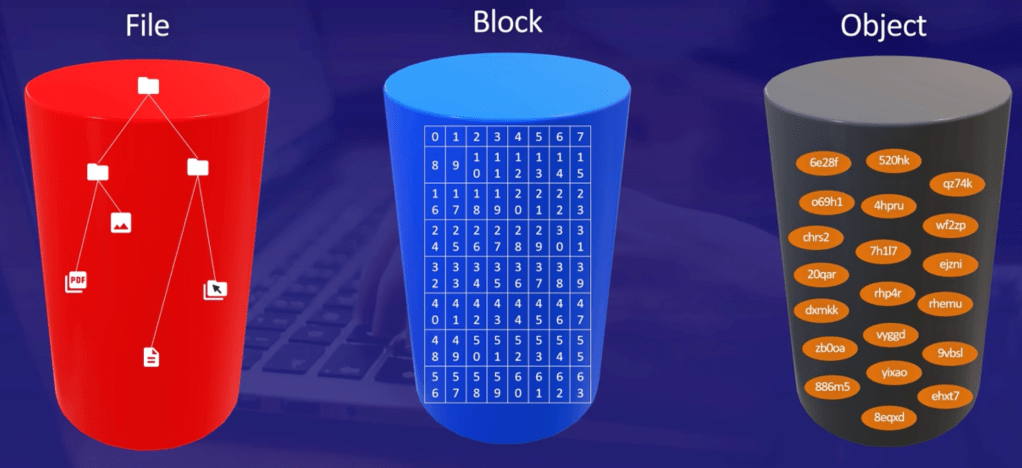
- File Storage
- Amazon EFS (Elastic File System): a scalable, elastic and cloud native Network file system
- Amazon FSx for wWindows File Server: a fully managed file storage for Windows Server
- Block Storage
- Amazon EBS: easy to use, high performance block storage
- Object Storage
- Amazon S3 (Simple Storage Service): store and retrieve any amount of data from anywhere in the world
- Backup
- AWS Backup: centrally manage and automate backups across AWS services
- Data Transfer
- AWS Storage Gateway: provide on-premises access to unlimited cloud storage
- AWS DataSync: easily transfer data to and from AWS up to 10 times faster than normal
- AWS Transfer Family: transfer files to Amazon S3 using SFTP, FTP and FTPS
- Simple Storage Service (S3)
- Industry leading durability: 11 9’s
- Different storage classes:
- Standard
- Standard-Infrequent
- One Zone-Infrequent
- Glacier & Glacier Deep Archive
- Data archival and long-term backup
- $1/TB/month
- Query-in-place functionality
- Three retrieval options:
- Standard – low cost
- Bulk retrieval – cost effective for large amounts
- Expedited – urgent retrieval
- Intelligent Tiering
- Amazon Elastic Filesystem (EFS)
- Highly available and durable
- Built-in protection from AZ outages and other failures
- Storage classes
- Standard
- Infrequent Access
- Automatically grows and shrinks
- Encrypted by default
- AWS Storage Gateway
- Gives you access to virtually unlimited cloud storage on premises
- Types
- File Gateway: gives you SMB and NFS interfaces to S3
- Tape Gateway: presents a virtual tape library on your local network
- Volume Gateway: presents an iSCSI block storage volume to your on-premises application
Databases
- Relational Databases
- Amazon Aurora: a mySQL and PostgreSQL compatible database built for the cloud
- Amazon RDS: easily set up, use and scale multiple database engines
- Amazon Redshift: a cloud data warehouse
- Key-Value Database
- Amazon DynamoDB: fast and flexible NoSQL database for any scale
- In-Memory Databases
- Amazon ElasticCache: managed, in-memory data store service for Redis, and Memocached
- Document Database
- Amazon DocumentDB: MongoDB compatible fast, scalable, highly available document database
- Relational Database Service (RDS)
- Easy to set up
- Fully managed
- Scalable
- Automated backups
- Automatic host replacement
- Cost effective
- DynamoDB
- Key-value document database
- Single-digit millisecond performance
- Fully managed
- Works in multiple regions
- Built-in security, backup and restore
- Can handle more than 20,000,000 requests per second
- Works great with serverless
Networking
- Cloud Network
- Amazon VPC: define and provision an isolated network for your AWS resources
- AWS Transit Gateway: connect VPSs and on-premises networks
- AWS Privatelink: provide private connectivity between VPCs and on-premises applications
- Amazon Route 53: host your own managed DNS
- Network Scaling
- Elastic Load Balancing: automatically distribute network traffic across a pool of resources
- AWS Global Accelerator: direct traffic through the AWS global network to improve global application performance
- Content Delivery
- Amazon CloudFront: securely deliver data, videos and applications to customers globally with low latency and high transfer speeds
- Amazon Virtual Private Cloud (VPC)
- Private gated community for your virtual machines and other services in AWS
- Control flow:
- NAT gateway
- Internet gateway
- Network access control list
- CloudFront
- Content delivery network
- Edge locations to reduce the delivery time
- Increases security
- Traffic spike protection
- Lambda@Edge
- Cost-effective
- Route 53
- DNS services
- DNS is kind of database, which IP addresses map to which domains
- Policies
- Simple Routing Policy
- Weighted Policy
- Geolocation Policy
- Latency Policy
- Failover Policy
- Multi-value Answer Policy
- DNS services
Management and Governance
- Account Management Services
- AWS Control Tower: set up and govern a secure multi-account AWS environment
- AWS Organizations: centrally govern and manage your environments across multiple AWS accounts
- AWS Budgets: improve your planning and cost control
- Provisioning Services
- AWS CloudFormation: model and provision all your resources via code
- AWS Service Catalog: create, organise and govern your own curated catalog of AWS products
- AWS OpsWorks: automate operations with Chef and Puppet
- AWS Marketplace: find, test, buy and deploy software that runs on AWS
- Operation Services
- Amazon CloudWatch: observe your services via metrics and logging
- AWS Config: record and evaluate configurations of AWS resources
- AWS CloudTrail: track all user activity across your AWS accounts
- AWS Systems Manager: optimize performance and security while managing a large amount of systems
- Amazon X-ray: analyse and debug production applications
- CloudFormation
- Version control
- Automation
- Scale
- CloudWatch
- Monitoring and observability services for AWS
- Collect metrics from services
- Integrates with 70+ AWS services
- Lots of pre-defined metrics
- Collect and display in various graphs
- Combined with Log Storage and Analysis
- Auto Scaling
- Auto scaling group
- Load Balancer
- High availability
- Better fault tolerance
- Better cost management
- EC2, DynamoDB, Aurora
Machine Learning
- ML AI
- Amazon Kendra: intelligent search
- Amazon Personalize: personalised recommendations
- ML Business Metrics
- Amazon Lookout for Metrics: detect unexpected changes; eg revenue performance and customer retention, and identify root causes
- Amazon Forecast: build accurate forecasting models
- Amazon Fraud Detector: identify potentially fraudulent online activities
- ML Vision
- Amazon Rekognition: analyse images and videos and extract meaning
- ML Language Services
- Amazon Polly: turn text into life-like speech
- Amazon Transcribe: add high quality speech to text capabilities to your application
- Amazon Lex: easily build conversational agents or chat bots
- Rekognition
- Object and Scene Detection
- Image Moderation
- Facial Analysis
- Celebrity Recognition
- Face Comparison
- Text Extraction
- Personal Protective Equipement (PPE) Detection
- DeepRacer
- CodeGuru
- Help code review
- Detect critical issues
- Find security vulnerabilities
- Point out hard-to-find bugs
AWS Certification Preparation Guide

- You remember things you understand
AWS Certified Cloud Practitioner (CLF-C01)
Foundations of Cloud Computing
- Cloud computing is the delivery of computing services over the internet
- Virtual Machines: virtualization lets you divide hardware resources on a single physical server into smaller units
- Usage: you pay only when you access it and only for what you use
- 6 Advantages
- Go global in minutes
- Stop spending money running and maintaining data centers
- Benefit from massive economies of scales
- Increase speed and agility
- Stop guessing capacity
- Trade capital expense for variable expense
- Benefits
- High Availability
- Elasticity
- Agility
- Durability
- Cloud Computing Models
- Infrastructure as a Service
- Building Blocks
- Web Hosting
- Software as a Service
- Complete Application
- Email Provider
- Platform as a Service
- Used by Developers
- Storefront Website
- Infrastructure as a Service
- Cloud Deployment Models
- Private Cloud
- Public Cloud
- Hybrid Cloud
- Region Characteristics
- Fully independent and isolated
- Resource and Service Specific
- Availability Zones (AZs)
- Consists of one or more physically separated data centers
- Edge locations
- Cache content for fast delivery to your users
- Reduce latency
Technology
- EC2
- Rent and manage virtual servers in the cloud
- Access to an EC2 instance
- AWS Management Console
- Secure Shell (SSH)
- EC2 Instance Connect (EIC) – no need to manage the SSH keys
- AWS System Manager
- Price Options
- On-demand: fixed price, down to the second
- Spot: cheapest
- Reserved Instances (RIs): Instance commit to 1 or 3 years
- Dedicated Hosts: gully dedicated to your instances
- Savings plan: Compute usage for 1 or 3 years
- Features:
- Elastic loading balancing according to incoming application traffic
- Auto Scaling, based on need and changing demand
- Lambda
- Serverless compute service that lets you run code without managing servers
- Features:
- Supports popular programming languages
- You author code using your favorite development environment or via the console
- Lambda can execute code in response to events
- Have a 15-minute timeout
- Pricing Model
- Compute time
- Request count
- Always free: 1 million free request every month
- AWS Fargate
- A serverless compute engine for containers
- Amazon Lightsail
- Allows you to quickly launch all the resources you need for small projects
- AWS Outposts (?)
- Allows you to run cloud services in your internal data center
- AWS Batch
- Allows your to process large workloads in smaller chunks (batches)
- S3
- Objects (files) are stored in buckets (directories)
- Regional service but has a global namespace
- EC2 Storage
- Elastic Block Store (EBS)
- A storage device (called a volume) that can be attached to or removed from instance
- Data persists when the instance stops
- Can only be attached to one instance in the same zone
- Instance Store
- A local storage that is physically attached to the host computer and cannot be removed
- Temporary
- Faster with hight I/O speeds
- Elastic File System (EFS)
- Serverless network file system for sharing files
- Only supports the Linux file system
- More expensive than EBS
- Accessible across different Availability Zones in the same Region
- Elastic Block Store (EBS)
- Storage Gateway
- A hybrid storage service
- Connect on-premises and cloud data
- AWS Backup
- Manage data backups across multiple AWS services
- Content Delivery
- A CDN is a mechanism to deliver content quickly and efficiently based on a geographic location
- CloudFront
- A CDN that delivers data and applications globally with low latency
- Uses edge locations to cache content
- Amazon Global Accelerator
- Sends your users through the AWS global network when accessing content, speeding up delivery
- S3 Transfer Acceleration
- Improves content uploads and downloads to and from S3 buckets
- VPC and Subcomponents
- VPC peering allows you to connect 2 VPCs together
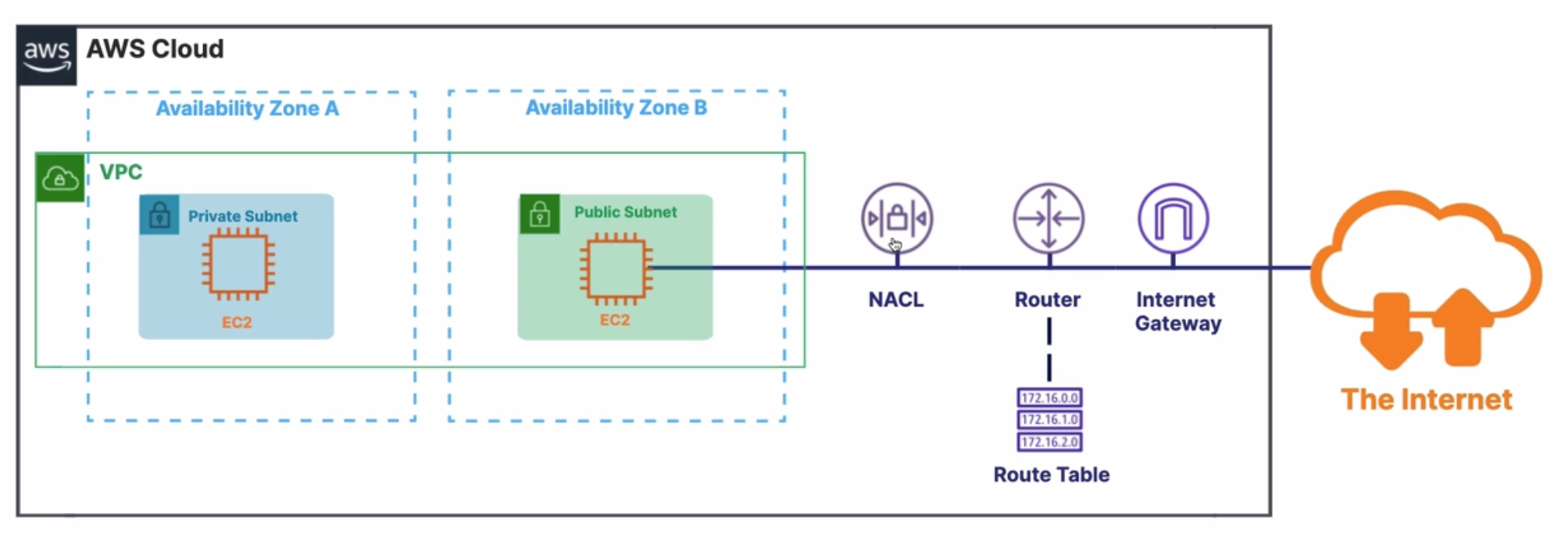
- VPC peering allows you to connect 2 VPCs together
- Route 53
- A DNS service that routes users to applications
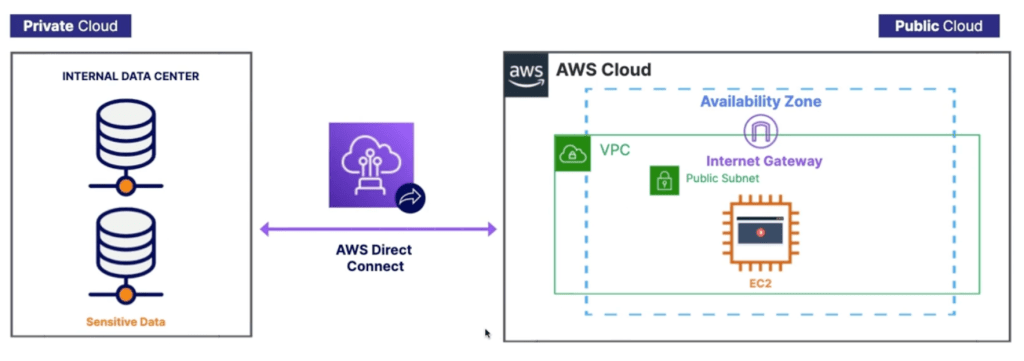
- Direct Connect
- A dedicated physical network connection from on-premises data center to AWS
- VPN
- Site-toSite VPN creates a secure connection between your internal network and AWS VPCs
- API Gateways
- Allows you to build and manage APIs
- Databases
- RDS
- Relational databases
- Aurora
- Relational database compatible with MySQL and PostgreSQL
- DynamoDB
- NoSQL key-value and document database
- Neptune
- Fully managed graph database
- ElastiCache
- Fully managed in-memory datastore
- DocumentDB
- NoSQL compatible with MongoDB
- RDS
- Migration and Transfer Services
- Database Migration Service (DMS)
- Migrate on-premises databases to AWS
- Virtually no downtime
- Server Migration Service (SMS)
- Migrate on-premise servers to AWS
- Server saved as a new Amazon Machine Image (AMI)
- Use AMI to launch servers as EC2 instances
- Snow Family
- Transfer large amount of data
- DataSync
- Online data transfer
- Database Migration Service (DMS)
- Analytics Services
- A data warehouse is a data storage solution that aggregates massive amounts of historical data from disparate sources
- Data warehouses support querying, reporting, analytics and business intelligence. They are not used for transaction processing.
- Amazon Redshift
- Data consolidation for reporting
- Athena
- A query service for Amazon S3
- Glue
- Prepares your data fro analytics
- Kinesis
- Analyse data and video streams in real time
- Elastic MapReduce
- Process large amount of data
- Using Hadoop
- Data Pipeline
- Move data between compute and storage services running either on AWS or on-premises
- QuickSight
- Visualise data
- Machine Learning
- Rekognition
- Automate image and video analysis
- Comprehend
- NLP
- Polly
- Turns text into speech
- SageMaker
- Build, train and deploy machine learning models quickly
- Translate
- Lex
- Build conversational interfaces like chatbots
- Rekognition
- Developer Tools
- Cloud9
- Integrated development environment
- CodeCommit
- Source control system for private Git repositories
- CodeBuild
- Build and test application source code
- CI/CD
- CodeDeploy
- CodePipeline
- Automates the software release process
- X-Ray
- Debug production applications
- CodeStar
- Cloud9
- Deployment and Infrastructure Management Services
- Infrastructure as Code (IaC)
- Write a script to provision AWS resources
- CloudFormation
- Allows you to provision AWS resources using IaC
- Elastic Beanstalk
- Allows you to deploy web applications and web services to AWS
- OpsWorks
- Allows you to use Chef or Puppet to automate the configuration of servers and deploy code
- Infrastructure as Code (IaC)
- Messaging and Integration Services
- Loose coupling
- Microservices
- Connected but not dependent on each other
- Queues are used to implement loosely coupled systems
- Simple Queue Service (SQS)
- Allows component-to-component communication using messages
- Multiple components can add messages to the queue
- Messages are processed in an asynchronous manner
- Simple Notification Service (SNS)
- Allows you to send emails and text messages from your applications
- Simple Email Service (SES)
- Allows you to send richly formatted HTML emails from applications
- Loose coupling
- Auditing, Monitoring and Logging Services
- CloudWatch
- A collection of services that help you monitor and observe your cloud resources
- Alarms
- Logs
- Metrics
- Events
- A collection of services that help you monitor and observe your cloud resources
- CloudTrail
- Tracks user activity and API calls within your account
- CloudWatch
- Additional Services
- Amazon WorkSpaces
- Allows you to host virtual desktops in the cloud
- Amazon Connect
- Cloud contact center service
- Amazon WorkSpaces
Security and Compliance
- Shared Responsibility Model
- AWS is responsible for protecting and securing their infrastructure
- Customer responsible for how the services are implemented and managing application data
- EC2 Shared Responsibility Model
- AWS
- EC2 Service
- Patching the host operating system
- Security of the physical server
- You
- Installed applications
- Patching the guest operating system
- Security controls
- Lambda
- AWS
- Lambda service
- Upgrading Lambda languages
- Lambda endpoints
- Operating system
- Underlying infrastructure
- Software dependencies
- You
- Security of code
- Storage of sensitive data
- IAM for permissions
- AWS
- AWS
- Well-Architected Framework
- 5 pillars describe design principles and best practices for running workloads in the cloud
- Operational Excellence
- Security
- Reliability
- Performance Efficiency
- Cost Optimization
- 5 pillars describe design principles and best practices for running workloads in the cloud
- IAM Users
- Principle of least privilege
- Application Security Services
- WAF (Web Application Firewall)
- Helps protect web applications against common web attacks
- Shield
- A managed Distributed Denial of Service protection service
- Macie
- Helps discovering and protecting sensitive data
- Config
- Allows to assess, audit and evaluate the configurations of resources
- GuardDuty
- An intelligent threat detection system that uncovers unauthorized behavior
- Inspector
- Works with EC2 instances to uncover and report vulnerabilities
- Artifact
- Offers on-demand access to AWS security and compliance reports
- Cognito
- Helps controlling access to mobile and web applications
- WAF (Web Application Firewall)
- Data Encryption and Secrets Management Services
- KMS (Key Management Service)
- Generate and store encryption keys
- CloudHSM
- A hardware security module used to generate encryption keys
- Secrets Manager
- Manage and retrieve secrets (PWs or keys)
- KMS (Key Management Service)
Pricing, Billing and Governance
- Understanding AWS Pricing
- Resources
- Compute
- Storage
- Outbound data transfer
- Free Offer Types
- 12 months free
- Always free
- Trials
- EC2
- On-Demand
- Savings Plan
- Reserved Instances
- Spot Instances
- Dedicated Hosts
- Lambda
- Number of requests
- Code execution time
- Always free
- S3
- Storage class
- Storage
- Data transfer
- Request and data retrieval
- RDS
- Running clock hours
- Type of database
- Storage
- Purchase type
- Database count
- API requests
- Deployment type
- Data transfer
- Total Cost of Ownership (TCO)
- Application Discovery Service
- Plan migration projects to the AWS Cloud
- Price List API
- Query the price of AWS services
- Resources
- Billing Services
- Budgets
- Set custom budgets that alert you when costs or usage exceed budgeted amount
- Types
- Cost Budgets
- Usage Budgets
- Reservation Budgets
- Cost and Usage Report
- Contains the most comprehensive set of cost and usage data
- Cost Explorer
- Visualize and forecast costs and usage over time
- Cost Allocation Tags
- Useful for tracking costs
- Budgets
- Governance Services
- Organizations
- Centrally manage multiple AWS accounts under one umbrella
- Control Tower
- Ensure your accounts conform to company-wide policies
- Systems Manager
- Gives visibility and control over AWS resources
- Trusted Advisor
- Provides real-time guidance to help provision resources following AWS best practices
- Organizations
- Management Services
Serverless Concepts
- Multi-tier Architecture
- Presentation
- Application
- Data
- Backend as a Service
- A bunch of APIs that are hosted by the cloud
- Function as a Service
- Provide code to be executed in the cloud by event-triggered containers that are dynamically allocated and ephemeral in nature
- Serverless Architecture
- A runtime architecture where infrastructure is entirely managed by a cloud service provider and resources are dynamically allocated on demand for a given unit of business logic
- Benefits
- Remove burden of infrastructure management
- Built-in Scaling
- Reduced operational costs
- Simplified Deployment
- Drawbacks
- Must keep less used applications warmed up
- Easy to become vendor locked
- Multi-tenancy concerns
- No ability for infrastructure optimization
- Monitoring can be complicated
- API Proxy & Gateway
- API Proxy: An http server that allows decoupling from backend services by routing calls to certain endpoints
- API Gateway: An API Proxy which provides advanced features such as authentication, input validation, monitoring and advanced request routing
- Serverless Technologies
- AWS Lambda
- Azure Functions
- Google Cloud Functions
 Yujin's Amusement Park