- Forms
- Elements in HTML forms maintain their own state and update according to input
- Controlled Components
- A React component controls the form it renders
- Single source
- Tie the form state to component state
- State mutation has an associated handler function
- Form Validation
- A React component controls the form it renders
- Uncontrolled Components
- Handle the form data by the DOM itself
- Instead event handle for state update, use a ref to get from values from the DOM
- Uncontrolled Form
- innerRef={(input) => this.username = input} to extract the value
- Design Patterns
- Well-documented solution to a recurring problem
- Software design pattern
- Reusable solution to commonly occurring problems
- The Model-View-Controller (MVC) Framework
- Goal:
- Isolation of domain logic from user interface
- Permits independent development, testing and maintenance (separation of concerns)
- Goal:
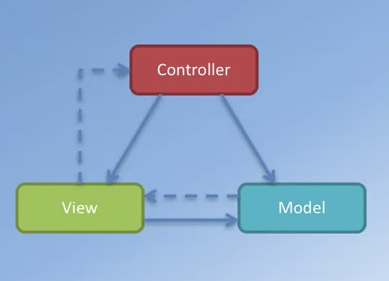
- View – presents the information to the user
- Model – stores domain state and domain logic and provides way of manipulating this state from the rest of the application
- Controller – mediates between the view and the model
- Flux Architecture
- Initially React was viewed as the “V” in MVC
- Issues with standard MVC architecture pattern
- Problems with cascading updates, decentralized mutations, race conditions
- Unidirectional Data Flow
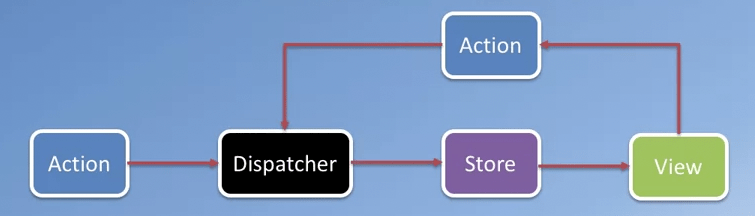
- Redux
- Predictable state container for JavaScript apps
- Main principles:
- Single source of truth
- Single state object tree within a single store
- State is read-only (only )
- Changes should only be done through actions
- Changes are made with pure functions
- Take previous state and action and return next state
- No mutation of the previous state
- Single source of truth
- Single store and single state tree enables
- Logging
- API handling
- Undo/redo
- State persistence
- “time-travel debugging”
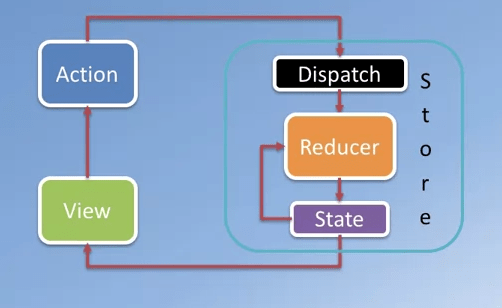
- Redux Concepts
- State – stored in plain JS object
- Action – plain JS object with a type field that specifies how to change something in the state
- Reducer – pure functions that take the current state and action and return a new state
- Update data immutably
- Redux Store
- Holds the current state value
- Created using createSore()
- Three methods
- dispatch() – states state update with the provided action object
- getState() – returns the current stored state value
- subscribe() – accepts a callback function that will be run every time an action is dispatched
- React with Redux
- react-redux package for bindings between React and Redux
- connect() – generates a wrapper “container” component that subscribes to the store
- mapStateToProps() – called every time store state changes, returns an object full of data with each field being a prop for the wrapped component
- mapDispatchToProps() – receives the dispatch() method and returns an object full of functions that use dispatch()
- Surround your App root with <Provider>
- Takes the store as an attribute
- Makes store accessible to all connected components
- connect() – generates a wrapper “container” component that subscribes to the store
- react-redux package for bindings between React and Redux
- React-Redux-Form
- Collection of reducer creators and action creators
- Form data stored in Redux store in a model
- Validation supports
- LocalForm
- Maps form model to local state of the component
- No need of form data persistence across component mounting/unmounting
- Validation supports retain
 Yujin's Amusement Park