The typeof operator returns a string indicating the type of the unevaluated operand.
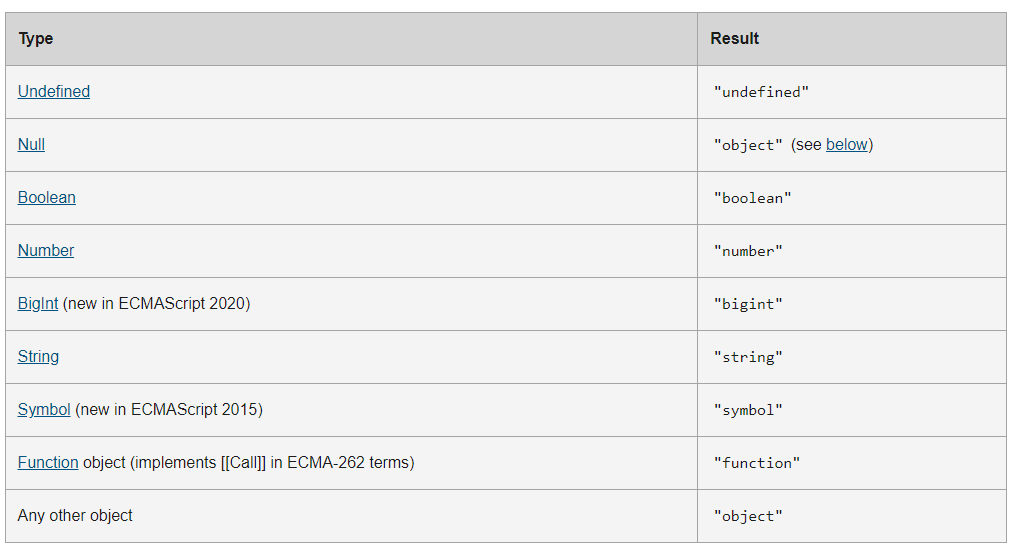
Special cases:

// Numbers
typeof NaN === 'number'; // Despite being "Not-A-Number"
typeof Number('1') === 'number';      // Number tries to parse things into numbers
typeof Number('shoe') === 'number';   // including values that cannot be type coerced to a number

// Strings
typeof `template literal` === 'string';
typeof '1' === 'string'; // note that a number within a string is still typeof string
typeof (typeof 1) === 'string'; // typeof always returns a string
typeof String(1) === 'string'; // String converts anything into a string, safer than toString

// Booleans
typeof Boolean(1) === 'boolean'; // Boolean() will convert values based on if they're truthy or falsy
typeof !!(1) === 'boolean'; // two calls of the ! (logical NOT) operator are equivalent to Boolean()

// Symbols
typeof Symbol() === 'symbol'
typeof Symbol('foo') === 'symbol'
typeof Symbol.iterator === 'symbol'

// Undefined
typeof undefined === 'undefined';
typeof declaredButUndefinedVariable === 'undefined';
typeof undeclaredVariable === 'undefined';

// Objects
typeof {a: 1} === 'object';

// use Array.isArray or Object.prototype.toString.call
// to differentiate regular objects from arrays
typeof [1, 2, 4] === 'object';

typeof new Date() === 'object';
typeof /regex/ === 'object'; // See Regular expressions section for historical results

// The following are confusing, dangerous, and wasteful. Avoid them.
typeof new Boolean(true) === 'object';
typeof new Number(1) === 'object';
typeof new String('abc') === 'object';

// Functions
typeof function() {} === 'function';
typeof class C {} === 'function';
typeof Math.sin === 'function';
https://developer.mozilla.org/en-US/docs/Web/JavaScript/Reference/Operators/typeof
 Yujin's Amusement Park