Big O Notation
Evaluate the performance of an algorithm (the worst case scenario)
| Notation      | Name            |
|---------------|-----------------|
| O(1)          | constant        |
| O(log(n))     | logarithmic     |
| O(n)          | linear          |
| O(n^2)        | quadratic       |
| O(n^c)        | polynomial      |
| O(c^n)        | exponential     |

Space Complexity
Only calculate the additional space relative to the size of the input.
Arrays
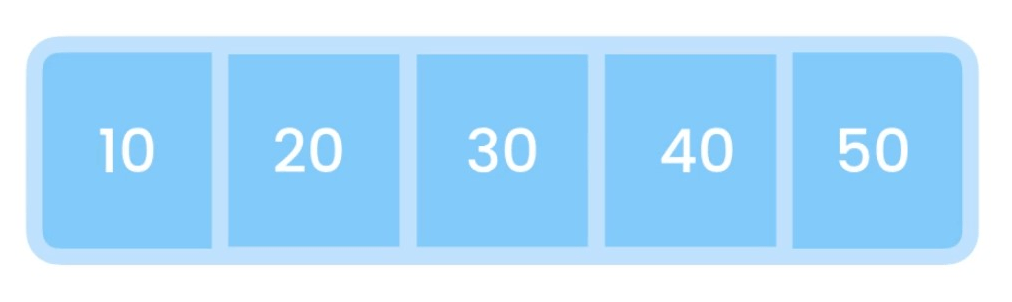
- Lookup by Index O(1): The items of a array are stored sequentially in memory, looking up item in an array with their index is super fast
- Lookup by value O(n)
- Insert O(n): Need to know the size of the array ahead, otherwise when overflow, have to create a new array and copy the old items into the new one
- Delete O(n): When the item is at the first position
In JavaScript and Python, Array is dynamic; while in Java, Array is static, ArrayList is dynamic.
Linked Lists
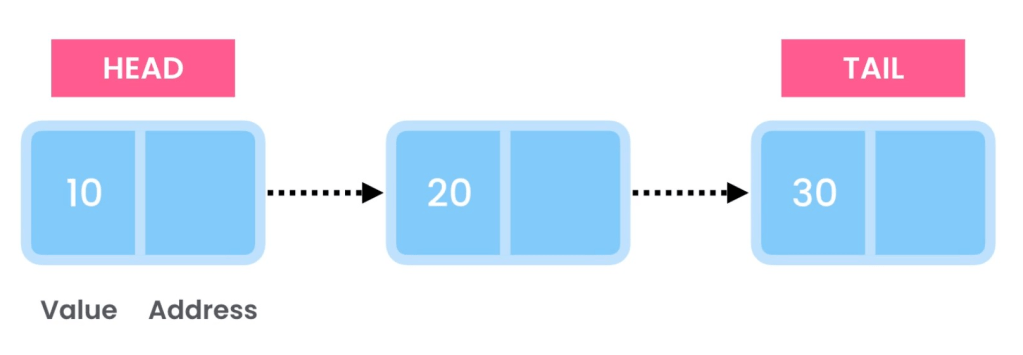
- To store a list of objects in sequence. Unlike array, linked lists can grow and shrink automatically.
- Each node has a value and an address which is the reference to the next node.
- Lookup O(n) by value & by index
- Insert
- O(1) at the end & at the beginning
- O(n) in the middle (search the position O(n), insert operation O(1))
- Delete
- O(1) from the beginning
- O(n) from the end, have to traverse the list all to the tail to find the node before last node
- O(n) in the middle (search the position O(n), insert operation O(1))
- Doubly: Delete from the end O(1)

- Circular

Array vs Linked List
- Space
- Static arrays have a fixed size
- Dynamic arrays grow by 50-100%, may waste memory
- Linked lists don’t waste memory, but need extra memory for keep address for next node
- Use arrays when you know the number of the items to store
Stacks
- Use cases:
- undo feature
- build compilers(syntax checking)
- evaluate expression (1 + 3 * 2 )
- navigation forward / back
- Last In First Out (LIFO)
- Operations O(1)
- push(item): add item on top of the stack
- pop(): return the item on top and remove it from the stack
- peek(): return the item on top without removing it
- isEmpty()
- Exercise:
- Reverse a string
- check if a string is a balanced string
- Two stacks in one array: stack 1 starts from head, stack 2 starts from end
- A stack that retrives the minimum value in constant time: a min stack holds the minimums
if(item < minStack.peek()) {
  minStack.push(item);
}
Queues
- First In First Out
- Use cases:
- Printers
- Operating systems
- Web servers
- Live support systems
- Operations: O(1)
- enqueue: add an item to the back of a queue
- dequeue: remove an item at the front of a queue
- peek: get the item at the front without removing it
- isEmpty
- isFull
- Implementation:
- Circular Array: with front and rear pointers, instead of reallocating when overflow to save the time complexity, the index map is the remainders of division by array length.
- Stack: two stacks, one for enqueue and one for dequeue, which is the reverse of the first stack
- Priority Queues: sorted queue, shift the items when insert a new item
Hash Tables
- Use cases:
- Spell checkers
- Dictionaries
- Compilers
- Code editors
- Implementation in different languages
- HashMap -> Java
- Object -> JavaScript
- Python -> Dictionary
- Dictionary -> C#
- Key-Value pairs, connected by hash function
- Deterministic: Always give the same result value when input is same
- Operations: O(1)
- Insert
- Lookup
- Delete
- If hash map allows null key or null values. Yes of both.
- Exercises:
- First non-repeating character
- Set: only keys and non-duplicated
- Every character in computer is represented by a number internally.
- Collision: two distinct keys generate the same hash value.
- Chaining: using a linked list to store multiple items in the same array index
- Open Addressing:
- linear probing: (hash(key) + i ) % table_size
generate cluster, result in slow inserting - quadratic probing: (hash(key) + i² ) % table_size
may result in infinite loop - double hashing: hash2(key) = prime – (key % prime)
(hash1(key) + i * hash2(key)) % table_size
- linear probing: (hash(key) + i ) % table_size
- Command query separation: a function should either be queries that return answers, or be commands that change the values
 Yujin's Amusement Park